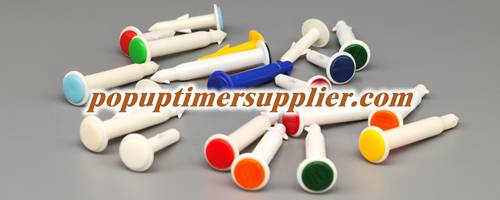
How Disposable Pop-Up Timers Are Manufactured: A Behind-the-Scenes Guide for Global Buyers
How Disposable Pop-Up Timers Are Manufactured: A Behind-the-Scenes Guide for Global Buyers
For global food manufacturers, importers, and distributors, understanding how disposable pop-up timers are manufactured helps buyers evaluate supplier capability and product reliability.
Although a disposable pop-up timer is a compact temperature indication device, producing a consistent and reliable product requires careful control of materials, components, assembly processes, and quality inspection.
This guide explains the manufacturing process of disposable pop-up timers and highlights the factors professional buyers should consider when selecting a production partner.
Disposable Pop-Up Timer Manufacturing Requires Specialized Experience
Disposable pop-up timers are designed for food applications where temperature indication performance and product safety are important.
A professional manufacturing process requires knowledge of:
- Food-grade materials
- Temperature activation technology
- Component precision
- Assembly consistency
- Bulk production control
For industrial buyers, supplier manufacturing experience directly influences product consistency.
Step 1: Material Selection and Component Preparation
The manufacturing process begins with carefully selected raw materials and components.
Important material considerations include:
- Food-grade PA66 housing and core components
- Food-derived thermal sensing wax
- Metal spring mechanism
- BPA-free material requirements
Proper material control helps ensure that finished products meet application requirements for commercial food production.
Step 2: Precision Component Manufacturing
Disposable pop-up timers contain multiple small components that must work together accurately.
Manufacturing consistency requires control over:
- Component dimensions
- Part fitting accuracy
- Assembly compatibility
- Production repeatability
Stable component production is especially important for large-volume orders where thousands or millions of units must maintain the same specifications.
Step 3: Temperature Activation System Assembly
The temperature activation mechanism is the key functional part of a disposable pop-up timer.
During production, manufacturers must control:
- Activation temperature settings
- Temperature response performance
- Mechanical movement reliability
- Batch consistency
Professional production processes ensure that each unit performs according to the required specification.
Step 4: Product Assembly and Quality Control
After components are prepared, the product moves into assembly and inspection stages.
Quality control may include:
- Visual inspection
- Component checking
- Performance testing
- Batch verification
Quality control is essential because commercial food customers depend on consistent product performance.
Step 5: Packaging and Bulk Shipment Preparation
Different customers require different packaging solutions depending on their business model.
Manufacturers may provide:
- Bulk carton packaging
- Industrial quantity packing
- Polybag packaging
- Blister card packaging
- Custom retail packaging
Flexible packaging capability allows suppliers to serve different international markets.
Why Manufacturing Experience Matters for Buyers
Choosing a supplier is not only about purchasing a finished product. Buyers are selecting a manufacturing system capable of supporting future demand.
Experienced manufacturers can provide:
- Stable production quality
- Better technical communication
- Improved customization support
- Reliable delivery planning
Why Specialized Production Creates Better Results
Manufacturers focusing on a single product category can continuously improve their production knowledge.
Long-term specialization helps suppliers understand:
- Customer application requirements
- Industry expectations
- Production challenges
- Quality improvement opportunities
Manufacturing Capability for Global B2B Buyers
International buyers usually require more than product availability.
They need suppliers capable of supporting:
- Large-volume orders
- OEM development
- Private label projects
- Export documentation
- Long-term cooperation
How Buyers Evaluate a Disposable Pop-Up Timer Factory
Before choosing a manufacturing partner, buyers should review:
- Years of product specialization
- Factory production capability
- Material information
- Quality systems
- Customization experience
- Export history
The Value of Working With a Direct Source Manufacturer
Direct factory cooperation provides closer communication between buyers and production teams.
This can help with:
- Faster product discussions
- Clearer technical requirements
- More efficient OEM projects
- Better supply planning
For companies purchasing disposable pop-up timers in bulk, a capable manufacturing partner can become an important part of the supply chain.
Frequently Asked Questions
How are disposable pop-up timers manufactured?
Disposable pop-up timers are produced through material preparation, component manufacturing, assembly, testing, quality control, and packaging processes.
Why is manufacturing experience important?
Experienced manufacturers usually have better control over product consistency and production processes.
What materials are used in disposable pop-up timers?
Professional products may use food-grade PA66 components, thermal sensing wax, and a metal spring mechanism.
Do manufacturers test disposable pop-up timers?
Professional suppliers use quality control procedures to maintain product consistency.
Can manufacturers customize pop-up timers?
Yes. OEM customization may include temperature settings, colors, logos, and packaging.
Why does production consistency matter?
Bulk buyers need products with stable specifications across large production quantities.
What industries purchase directly from manufacturers?
Food processors, poultry companies, distributors, and private label brands commonly purchase directly from manufacturers.
What makes a factory different from a trading company?
A factory controls production directly, while a trading company typically sources products from manufacturers.
Can manufacturers support international customers?
Experienced export manufacturers can support global B2B customers with bulk and OEM requirements.
Why choose a specialized disposable pop-up timer manufacturer?
Specialized manufacturers usually provide deeper product knowledge and stronger technical support.
Disclaimer: "Pop-Up Timer" is a generic industry term used for disposable cooking temperature indicators. We are an independent China-based direct-source manufacturer specializing in disposable pop-up timers and are not affiliated with VOLK or any other third-party brand. Any brand references are provided only for identification and comparison purposes.