Why Industrial Food Producers Are Re-Evaluating Disposable Pop-Up Timer Procurement
Why Industrial Food Producers Are Re-Evaluating Disposable Pop-Up Timer Procurement
In industrial food production, timing is not a matter of convenience—it is a matter of safety, compliance, and consistency. Over the past decade, many meat processors, central kitchens, and frozen food manufacturers have quietly started to reconsider one small but critical component in their workflow: the disposable pop-up timer used in thermal processing.
For years, procurement decisions around this component were largely driven by price and availability. However, as global food safety standards tighten and production lines become more automated, the hidden risks of low-precision or inconsistent timers have become harder to ignore. A deviation of even a few degrees can mean under-processed products, failed audits, or costly batch rework.
Modern industrial buyers are now prioritizing suppliers that can demonstrate not only cost stability but also technical consistency, certification compliance, and long-term manufacturing capability. This shift is especially visible in high-volume operations such as poultry processing plants, beef and pork slaughterhouses, ready-meal factories, and large-scale catering facilities.
The Technical Reality Behind Disposable Pop-Up Timers
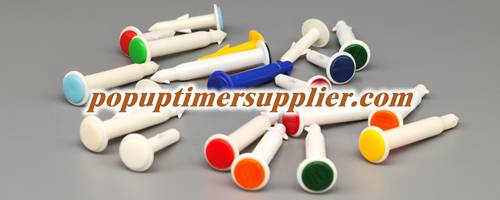
Although the product appears simple, a disposable pop-up timer is a precision thermal-response device. Inside a compact food-grade housing, a calibrated temperature-sensitive material triggers a metal spring mechanism at a specific internal temperature threshold. Once activated, the indicator “pops up,” signaling that the product has reached the required doneness or safety level.
In consistent industrial use, the reliability of this mechanism depends on several core factors: material stability, calibration accuracy, and environmental resistance during storage and cooking cycles.
Leading manufacturers in this field typically rely on food-grade PA66 nylon for housing and internal structure, ensuring heat resistance and dimensional stability. The thermal element is commonly based on food-extracted wax compounds engineered for predictable phase change behavior, while the actuation system depends on precision metal springs designed for repeatable force thresholds.
Where Procurement Risks Often Begin
Procurement teams often discover quality issues only after integration into production lines. The most common problems include inconsistent triggering temperatures, delayed activation under real cooking conditions, or premature failures during storage due to material instability.
These issues rarely originate from the concept of the product itself, but rather from variations in manufacturing discipline. Small differences in wax composition, spring calibration, or molding precision can produce significant deviations at scale.
As a result, industrial buyers are increasingly shifting away from fragmented sourcing models toward direct factory partnerships that can ensure repeatability across large production batches.
Factory-Direct Manufacturing as a Strategic Advantage
Since 2006, specialized manufacturers focusing exclusively on disposable pop-up timers have built production systems optimized for consistency rather than diversification. This single-product focus allows tighter process control, deeper calibration expertise, and more stable long-term supply.
In factory-direct models, procurement teams benefit from reduced supply chain layers, which typically results in better traceability and more predictable lead times. More importantly, it allows technical communication to occur directly with the production source, minimizing interpretation errors between design intent and mass manufacturing output.
For large-scale buyers, especially those operating under FDA, EU, or BRC audit frameworks, this direct relationship can significantly simplify compliance documentation and quality assurance validation.
Material Compliance and Food Safety Expectations
Modern regulatory environments require that all food-contact components meet strict material safety standards. High-grade disposable pop-up timers are typically produced using BPA-free structures and food-safe materials that comply with FDA and EU requirements.
The internal thermal system must also avoid any heavy metal contamination risks, relying instead on stable organic or food-extracted compounds designed specifically for controlled thermal expansion behavior. Combined with precision metal springs and controlled assembly environments, these factors ensure consistent performance in regulated food production systems.
The Direction of Procurement in Industrial Food Processing
The future of procurement in this category is moving toward technical transparency. Buyers are no longer satisfied with generic product descriptions; they expect measurable specifications, certification-backed materials, and production traceability.
In this context, suppliers that can demonstrate long-term specialization and export-focused manufacturing discipline are becoming preferred partners in global supply chains.
As production volumes increase and safety margins become tighter, disposable pop-up timers are no longer viewed as simple indicators, but as integrated quality control tools within thermal processing systems.